Start here
How to choose a kayak cart
The full decision process: rigged weight first, then hull shape, then terrain, then storage. Why "universal fit" tells you nothing, and the specification claims worth distrusting.
Almost every kayak cart buying guide starts with a ranked list of products. That is the wrong end of the problem. The cart that is perfect for a 25 kg sit-on-top on a concrete ramp is actively dangerous under a 65 kg pedal kayak on soft sand, and no ranking can resolve that for you.
What follows is the order we work in, and the order the finder works in. Each step can eliminate carts entirely, so working in this sequence saves you from falling in love with something that was never going to work.
The order that matters
- Real carry weight — what the loaded boat actually weighs. Eliminates carts on capacity.
- Hull shape — whether the cart can support your hull without point-loading it.
- Terrain — whether the wheels work on the ground between your car and the water.
- Storage — whether the cart goes with you, or waits in the car park.
- Materials — whether it survives your environment for more than two seasons.
Price comes last, and deliberately so. A cart that fails any of the first three is not a bargain at any price — it is either an inconvenience or a cracked hull.
1. Real carry weight, not the brochure weight
This is where most buyers go wrong before they have even looked at a cart. Manufacturers publish hull weight: the bare boat, no seat, no drive, nothing aboard. Nobody carts that boat.
A Hobie Mirage Pro Angler 14 is listed at around 54.7 kg as a fitted hull, but 65.5 kg fully rigged. Add a loaded tackle crate at roughly 7 kg, a battery, a fish finder, four rods and some water, and you are comfortably past 85 kg. If you sized your cart against the 54.7 kg figure, you have chosen a cart that is over 50 percent beyond what you assumed.
The items people forget
A loaded tackle crate. Ice in the cooler — one kilogram per litre. Water trapped in the hull and soaked into foam pads, which is real and typically a couple of kilograms. The anchor and chain. Overnight camping kit, if you are an expedition paddler.
Work out your figure on the Real Carry Weight calculator, then apply a margin. Our load bands treat anything above 85 percent of rated capacity as near maximum, and there is a reason for that: rated capacities assume even loading on reasonable ground. A cart at 95 percent on paper is at its limit the first time one wheel drops into a rut.
Capacity figures are less trustworthy than they look
During our research we found the same cart model quoted at 170, 175, 260, 265 and 300 pounds across different retailers and review sites. That is not a rounding difference — it is a spread of nearly two to one for one SKU. Our best explanation is that capacity varies by wheel configuration and nobody says so.
Where figures conflict irreconcilably, we publish a planning capacity based on the most conservative credible figure, mark it provisional, and show you the dispute. Where we cannot establish anything defensible, we refuse to give a load verdict at all. A confident number would be more comfortable and less honest.
2. Hull shape and how the cart touches it
The cart carries your boat through two small contact patches. If those patches sit on the wrong part of the hull, you get one of three outcomes: the boat rolls, the boat scratches or dents, or in the worst case the hull deforms under sustained point load.
Flat pads versus contoured bunks
Flat pad, rounded hull. Contact is a narrow strip near the keel. The boat wants to roll and the strap is the only thing resisting it.
Contoured bunk, same hull. The pads meet the hull along a curve, the boat settles in, and the strap only has to stop it lifting.
The four hull shapes, and where a flat pad touches each
Illustrative cross-sections of hull classes, not scale drawings of specific kayaks.
Flat pads work well on flat-bottomed and pontoon-hulled boats — which is most modern fishing kayaks. They work poorly on rounded and shallow-V touring hulls, where the hull touches the pad along a narrow line and wants to roll. This is one of the most consistently reported complaints about flat-pad carts, and owners routinely fix it themselves by shaping foam cradles.
Contoured bunks cradle rounded hulls and generally suit a wider range of boats, which is why we treat bunk geometry as a positive in the compatibility engine.
Width adjustment is not the same as fit
Plenty of carts advertise a wide adjustment range. That tells you the pads can be moved apart. It says nothing about whether the pads meet your hull at a sensible angle, or whether the crossbar clears your drive well. Check what sits between the pads as carefully as the span itself.
Fittings the cart must miss
Pedal drive wells, rudder assemblies, transducer shields, hatch lids and keel strips are all places a cart must not bear on. Our kayak records list the ones we have documented per model, and the positioning guide shows where the cart should sit instead.
3. The ground you actually cross
Be honest about the worst surface on your regular route, not the average one. A cart that handles the car park beautifully and then bogs in the last 30 metres of dry sand has failed.
The single most important thing to understand: tyre width determines flotation, tyre diameter determines obstacle clearance. Soft sand is a flotation problem. A large-diameter narrow wheel — very common, often marketed as all-terrain — cuts into dry sand exactly like a small one, just with more leverage.
Low-pressure polyurethane balloon wheels, run at around 0.17 bar (2.5 psi), are the genuine answer for soft sand. Everything else is a compromise. Some manufacturers are refreshingly direct about this: YakAttack state plainly that their standard 30.5 cm airless wheel is for hard-packed surfaces and is not a sand tyre, and sell a separate sand configuration. Believe manufacturers when they tell you what their product is not for.
The wheel selector compares every wheel option we hold across eight surfaces.
4. Storage: does the cart come with you?
There are two philosophies, and you need to decide which you are before you buy.
- The cart stays behind. You wheel to the water, remove the cart, leave it in the car or chained at the launch. Larger, more capable carts fit here — you are not constrained by pack size.
- The cart comes aboard. Essential if you land somewhere else, do point-to-point trips, or simply do not trust leaving it. Now folded dimensions and hatch compatibility become hard requirements, and several otherwise excellent carts are eliminated immediately.
If the cart must pack, measure your hatch before shopping. Carts that disassemble tool-free into a handful of parts, or that fold to something like 88 × 33 × 10 cm, are the ones worth looking at. Our cart records list folded dimensions where the manufacturer publishes them.
5. Materials, corrosion and the two-season question
If you paddle in saltwater, materials stop being a detail. The pattern is straightforward:
- All-plastic frames with stainless axles behave very well in salt. Nothing to rust.
- Anodised aluminium is a good compromise: light, strong, corrosion-resistant.
- Powder-coated steel is strong and cheap, and rusts as soon as the coating chips. At least one manufacturer recommends applying a corrosion protectant, which tells you what they expect to happen.
Whatever you buy, the rinse routine matters more than the material — see saltwater cart care.
Why “universal fit” is meaningless
“Fits all kayaks” is a statement about the retailer’s returns policy, not about your hull. We treat it as carrying no information whatsoever, and we would encourage you to do the same.
The proof is easy to find. One of the most popular carts in the world is explicitly reported as not fitting certain wide, flat-hulled sit-on-tops — a documented non-fit that appears in owner forums while the product page still says universal. Both things are true at once: the cart is excellent, and it does not fit that boat.
What universal fit cannot cover
It cannot cover a hull shape the pads do not match, a rigged weight beyond the frame’s capacity, a drive well where the crossbar wants to sit, or a scupper the manufacturer says must not carry load. Those are the four ways carts actually fail, and none of them are addressed by an adjustable width range.
Specification claims worth distrusting
| The claim | What to actually check |
|---|---|
| “450 lb capacity” | Whether other sources agree, and whether the figure is for flat ground or for real terrain. One manufacturer honestly publishes three tiers for one cart: 450 lb flat, 300 lb on trail, 200 lb over a 5-inch drop. Most publish only the biggest number. |
| “All-terrain wheels” | The tyre width in centimetres. Under about 10 cm, dry sand is out of scope regardless of the label. |
| “Fits all kayaks” | Pad type and geometry against your specific hull shape. |
| “Marine grade” | Which parts. A stainless axle on a powder-coated steel frame is not a marine-grade cart. |
| “Includes straps” | What kind. Several quality carts ship with no straps at all and say so; others include a strap with a buckle that owners immediately replace. |
| “Tested by our experts” | Whether any testing methodology is published. If a site cannot tell you how it tested, assume it did not. |
The cart types, briefly
Platform and bunk carts
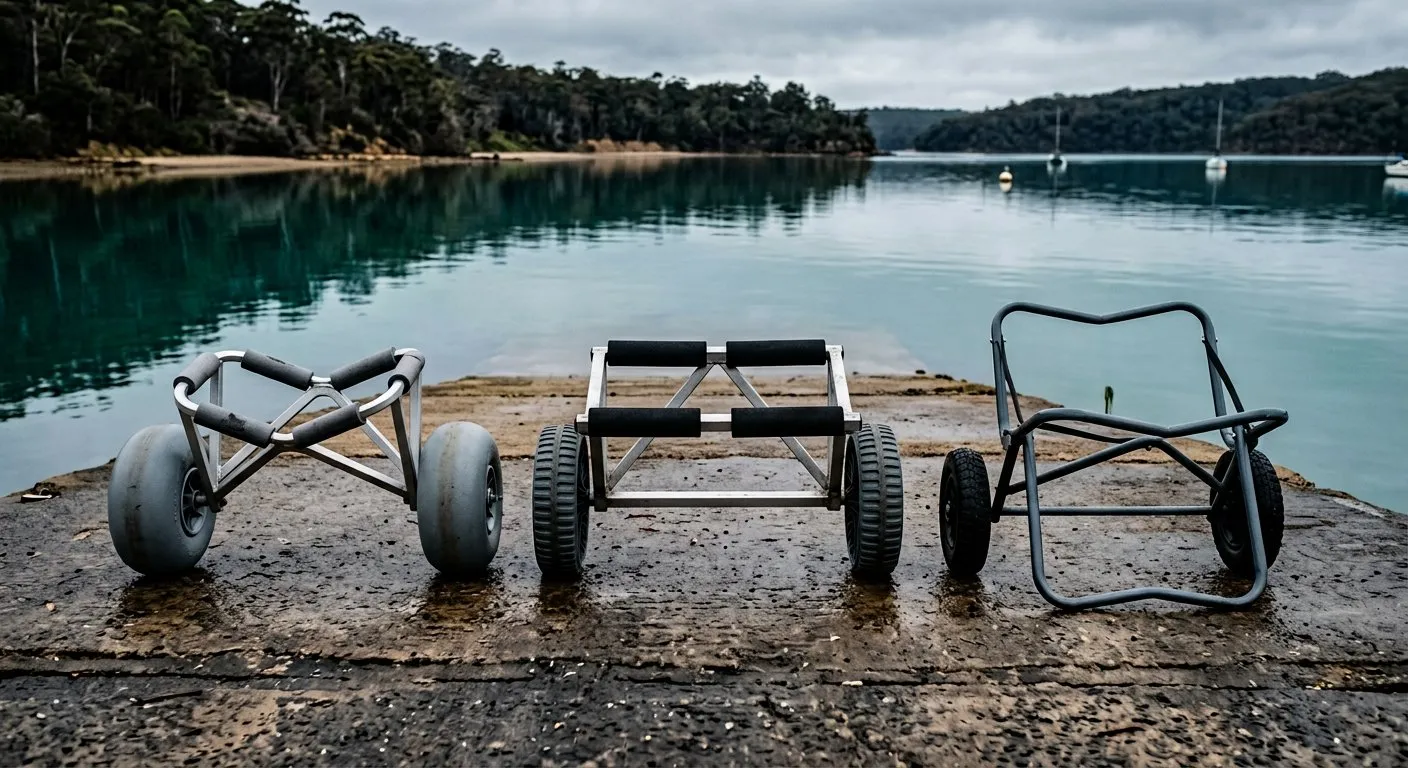
The boat sits on top, held by a strap. The most broadly compatible design and the right default for heavy pedal kayaks. Stability depends on pad geometry matching your hull and on the cart being positioned correctly.
Scupper carts
Posts plug up into scupper holes. Convenient and quick, and genuinely fine on boats whose manufacturers design for it. Dangerous on boats whose manufacturers do not. Read scupper cart safety before buying one — this is the one category where the wrong choice can crack your hull rather than just annoy you.
End carts and strap-on trolleys
A small wheeled unit at one end while you carry the other. Compact and cheap, and fine for light boats over short distances. You are still carrying half the weight.
Beach and balloon-wheel carts
Purpose-built for soft sand, with wide low-pressure wheels. Frequently lower in capacity than heavy-duty platform carts, so check the load margin carefully — this is a common trap for heavy fishing kayaks on sandy coasts.
What more money actually buys
Not much frame strength, past a certain point. What it buys is: parts availability, corrosion resistance, wheels appropriate to difficult ground, and honest specifications. A cart you can buy a new kickstand for in five years is a different proposition from one that becomes landfill when a moulded part snaps — see replacement parts and repairability.
The cheapest genuinely useful upgrade to almost any cart, at any price point, is a 25 mm cam strap to replace the factory one. That is covered in strapping a kayak to a cart properly.
Put your own numbers through it
Everything above is applied automatically by the Kayak Cart Finder: your boat, your load, your terrain, against every cart we hold, with the reasoning shown for each verdict rather than a score out of ten.
Check this against your own boat
General advice only gets you so far. The finder runs your kayak, your loaded weight and your launch terrain against every cart we hold.
Other guides
Technique
Strapping a kayak to a cart properly
Strap slip is the second most common cart complaint and it is almost always fixable.
Hull safety
Scupper cart safety
Scupper holes are moulded drains, not designed load points.
Terrain
Moving a kayak across soft sand
The surface that defeats most carts.
Ownership
Saltwater cart care
Salt and sand destroy carts faster than use does.