Technique
Strapping a kayak to a cart properly
Strap slip is the second most common cart complaint and it is almost always fixable. Correct buckle threading, why you run the strap through the carry handles, and what to replace a factory strap with.
Strap failure is the second most common kayak cart complaint we found, behind only sand. It is also the most fixable. In almost every case the cart is fine, the boat is fine, and the strap is being threaded or routed in a way that guarantees it will creep.
Why straps slip
Three things are happening at once when a kayak on a cart works its strap loose:
- The hull is smooth, wet and often waxed. There is very little friction between a polyethylene hull and a nylon strap. On a wet boat there is almost none.
- Every bump applies a shear pulse. The boat wants to move fore and aft relative to the cart, and each small movement lets a few millimetres of strap through the buckle.
- A poorly positioned cart makes it far worse. If the cart sits well behind the balance point, the boat seesaws on the axle and drives much larger movements into the strap. Fixing your cart position is often the real fix for a strap problem.
Once the strap starts creeping, the cart migrates towards the stern, the boat tips further, and on soft ground the whole thing can drag the trolley over. Owners describe exactly this sequence.
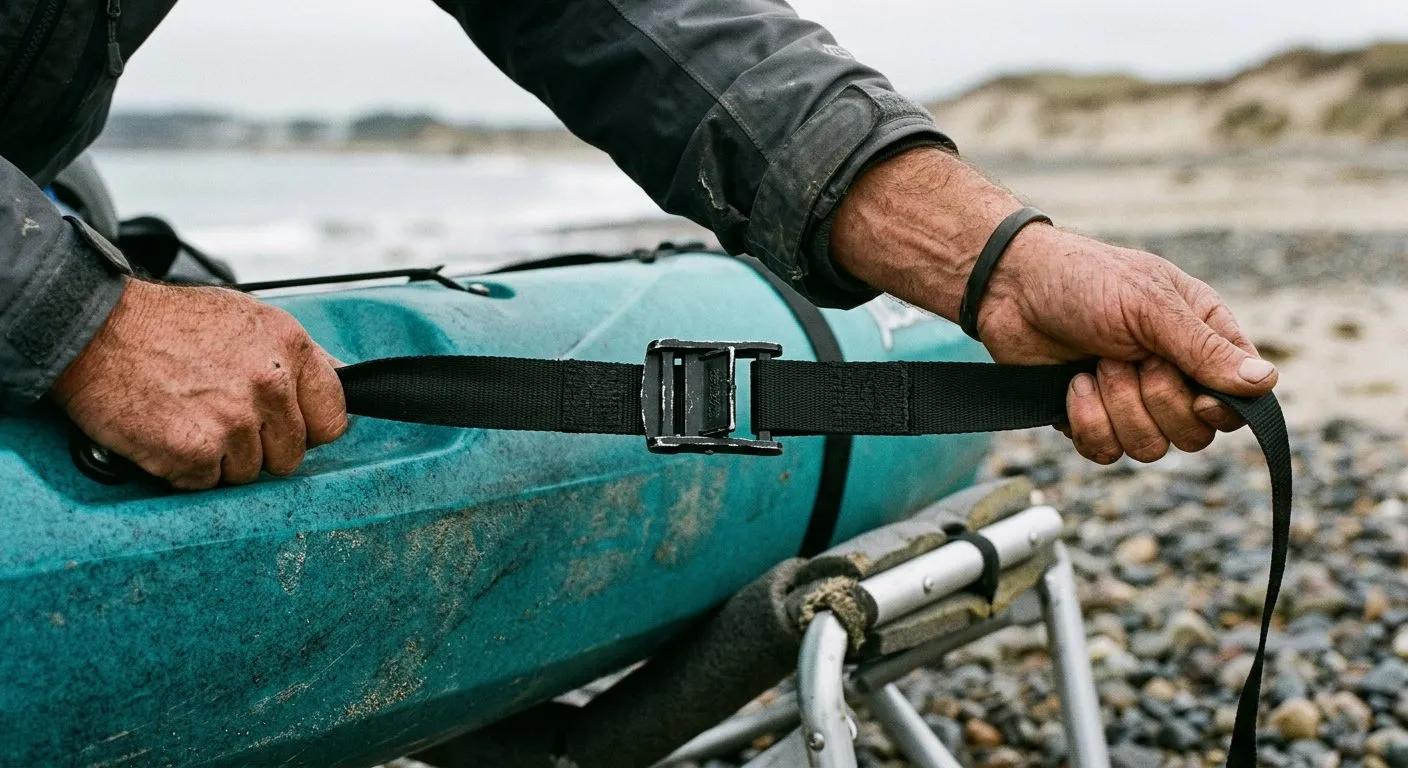
Threading a cam buckle so it actually locks
This is the step that is under-documented everywhere, and it is the difference between a strap that holds and one that does not. Many cart straps use a plain cam buckle with a smooth or lightly toothed cam.
- Pass the free end of the strap up through the buckle from underneath, under the cam.
- Pull it through and tension it. The cam bites down on the strap as load comes on.
- Now feed the tail back down through the buckle slot, so the strap doubles back on itself through the frame of the buckle. This is the part people skip.
- Pull the tail snug and secure it — a half hitch around the standing part, or through the keeper.
That doubling-back turns a friction grip into a mechanical one. A cam buckle whose teeth are worn, or which never had aggressive teeth to start with, relies entirely on this. Hobie forum users troubleshooting carts sliding off wet hulls arrive at exactly this fix, alongside replacing the factory strap.
If the buckle pops open on its own
Some factory cart buckles have no meaningful teeth and will release under vibration. If yours opens by itself, stop diagnosing and replace it. A strap that releases while you are carting a 60 kg boat down a ramp is a genuine hazard, not an inconvenience.
Run the strap through the carry handles
A strap that only passes over the hull can slide along it. A strap that passes through the side carry handles cannot — the handles are fixed hard points, and they stop the strap migrating fore and aft no matter how wet the boat is.
This single change resolves most residual slip once the buckle is threaded correctly. Where the handle positions do not line up usefully with the cart, look for any other fixed hard point: a moulded tie-down padeye, a scupper you have already confirmed is structural, or the frame of a fitted seat.
Do not improvise a hard point
Never run a load-bearing strap through a scupper hole you have not confirmed is designed for it. Most scuppers are moulded drains with no reinforcement, and a strap under tension through one applies exactly the kind of point load that cracks hulls. See scupper cart safety.
The full method, start to finish
- Position the cart first. Just aft of the loaded boat’s balance point, pads on solid hull, clear of drive wells, rudders, transducers and hatches.
- Settle the boat onto the pads. Rock it gently so it finds its natural seat rather than sitting on one edge.
- Pass the strap over the hull and through both carry handles. Keep it square — a strap running diagonally will pull the cart out of alignment as it tensions.
- Thread and tension the buckle as above, then double the tail back through the slot.
- Test before you walk. Lift the bow and rock the boat firmly side to side, then fore and aft. The cart must not move relative to the hull. If it does, re-do it here rather than on the beach.
- Walk two metres, then re-tension. Straps bed in. This second tug is the one people skip and then blame the cart.
- Secure the tail. A loose strap end will find your wheel.
Choosing a strap
Several good carts ship with no straps at all — YakAttack are explicit that 25 mm cam straps are not included with the Bunkster, for instance. Others include something you will want to replace. Either way, this is the cheapest worthwhile upgrade you can make.
- 25 mm (1 inch) polyester cam strap is the standard answer. Wide enough to spread load, narrow enough to thread through handles easily.
- Polyester over nylon. Nylon stretches when wet, which is precisely when you do not want it to. Polyester holds its length.
- A padded or coated buckle saves your gelcoat and your knuckles.
- Two shorter straps beat one long one on wide fishing kayaks, giving you independent tension at each bunk.
- Avoid ratchet straps. They generate far more force than a plastic kayak hull should ever see, and it is genuinely easy to deform a hull with one.
Common mistakes
| Mistake | What happens |
|---|---|
| Strap over the hull only, not through handles | The strap migrates along a wet hull and the cart walks towards the stern. |
| Tail not fed back through the buckle slot | The cam relies on friction alone and creeps under vibration. |
| Over-tightening with a ratchet | Hull deformation, and on thin-walled boats a permanent dent. |
| Strapping a badly positioned cart | No amount of tension fixes a seesawing boat. Fix the position. |
| Not re-tensioning after the first few metres | Bedding-in slack becomes strap creep. |
| Loose tail left dangling | It wraps the axle or the wheel, usually at the worst moment. |
This is not roof-rack strapping
Cart straps and roof straps are different jobs with different loads. A cart strap holds a boat against gentle shear at walking pace. A roof strap resists 100 km/h airflow, crosswind and emergency braking, and needs bow and stern lines as well.
Never use a cart strap as your only roof restraint, and never assume a strap that has been dragged through sand and salt for two seasons still has its full rated strength. Inspect webbing for abrasion and UV chalking, and retire anything with cuts or heavy fraying.
If the cart still shifts
Correctly strapped, correctly positioned, and it still will not stay put? At that point you may genuinely have a fit problem rather than a technique problem — flat pads under a rounded hull, most likely. Check the pairing in the compatibility matrix.
Check this against your own boat
General advice only gets you so far. The finder runs your kayak, your loaded weight and your launch terrain against every cart we hold.
Other guides
Start here
How to choose a kayak cart
The full decision process: rigged weight first, then hull shape, then terrain, then storage.
Hull safety
Scupper cart safety
Scupper holes are moulded drains, not designed load points.
Terrain
Moving a kayak across soft sand
The surface that defeats most carts.
Ownership
Saltwater cart care
Salt and sand destroy carts faster than use does.