Independent since 2011
Will this cart actually fit your kayak?
Most cart listings say "universal fit". That is a marketing phrase, not a measurement. We match your exact model against hull shape, real loaded weight and launch terrain — and we tell you our evidence level for every single claim.
- Carts profiled
- 7
- Kayak models
- 8
- Invented specs
- 0
The problem is not choice. It is that nobody will commit to a number.
When we audited the current crop of "best kayak cart 2026" articles, we found the same product listed at five different weight capacities across five sites. One retail listing managed three contradictory capacities on a single page — in the title, in a bullet point, and in the spec table.
Meanwhile the ways carts actually fail are specific and well documented by owners: flat pads under rounded hulls, straps that slip on a wet boat, solid wheels that plough into dry sand, kickstands that fold while you are loading, and scupper holes that crack because a drainage hole was asked to carry 60 kg.
This site exists to answer one question properly, with sources attached, and to say "we don't know" out loud when that is the honest answer.
A live example
The Railblaza C-Tug is one of the best-selling kayak carts in the world. Here is its published capacity:
- 77 kg (170 lb) Amazon bullet point
- 79 kg (175 lb) Amazon spec table
- 118 kg (260 lb) Specialist retailers
- 120 kg (265 lb) Other retailers
- 136 kg (300 lb) Amazon product title
Three of those figures come from the same page. We publish the conflict rather than pick a favourite. See the full record.
Start with your actual situation
Four common cases. Each goes straight to a reasoned answer, not a top-ten list.
Soft sand beach
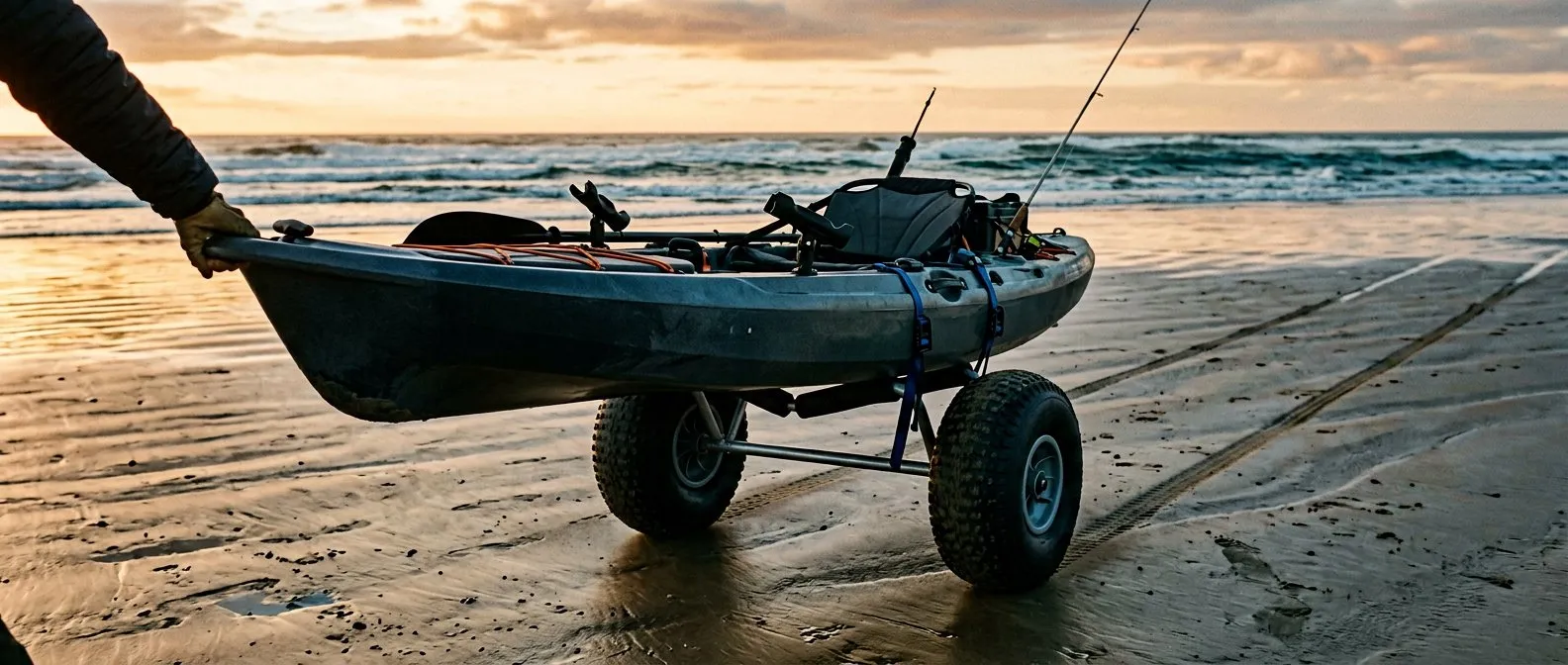
Deep dry sand that stops solid wheels dead.
Usually the answer
Balloon wheels, roughly 30 cm and wide
Car park to ramp
Sealed surfaces and firm gravel paths.
Usually the answer
A bunk cart on hard-surface wheels
Heavy rigged fishing kayak
Pedal drive, battery, crate — 60 kg and up.
Usually the answer
High-capacity wide-stance platform cart
Cart must fit in the hatch
You want the cart to travel in the boat.
Usually the answer
A compact folding cart under 70 cm packed
Fit is a cross-section problem
A cart holds your boat in one of four ways, and the difference decides whether the hull sits still or rolls against the strap. This is the view that answers the question — looking straight down the length of the kayak at the support underneath it.
Contoured bunks
Shaped pads meet the hull along a curve. The boat settles into the cart and the strap only has to stop it lifting.
Flat platform
Under a rounded hull the contact is a narrow strip, so the boat wants to roll and the strap becomes the only thing holding alignment.
V-cradle, balloon wheels
The V self-centres the hull. Wide low-pressure tyres spread the load so the wheel floats on sand instead of cutting into it.
Scupper posts
Posts locate the boat; the crossbar must carry it. If the hull rests on the posts alone, drainage holes are taking the whole load. Why that cracks hulls.
Diagrams show the general mechanism of each cart class. They are illustrative cross-sections, not scale drawings of any particular product, and no dimension should be read off them.
How the finder decides
Four checks, applied in order. Any one of them can rule a cart out on its own — and the rules are published in full so you can audit them.
- 01
Real carry weight
Your fully rigged weight, not the brochure hull weight. Drive units, batteries and a loaded crate routinely add 25–40 kg.
- 02
Hull geometry
Rounded, tunnel and pontoon hulls need cradling. Flat pads under a round hull make the strap the only thing holding your boat on.
- 03
Load margin
Not just "does it fit under the rating" — how much headroom is left for kerbs, roots and shock loading.
- 04
Terrain and wheels
Contact width matters more than diameter on sand. A 30 cm solid wheel still ploughs; a 30 cm balloon wheel floats.
Before you buy a scupper cart
Scupper holes are drainage features. They are not, by default, structural mounting points. Hobie state plainly that cart damage to scuppers is not a warranty issue, and the usual outcome of a cracked scupper is hull replacement. Dealers recognise the radiating stress-crack pattern on sight and treat it as user-caused damage.
A post fitting into a hole tells you nothing about whether that hole can carry your boat. Our finder will not recommend a scupper cart where the manufacturer advises against it, and it will not treat "we couldn't find the spec" as permission.
Read the scupper cart safety guideThe five things worth reading
Written once, properly, instead of forty thin posts.
The complete kayak cart buying guide
Every decision that matters, in the order you should make them.
Scupper carts and hull damage
When they are fine, when they crack hulls, and how to tell the difference.
Strapping that does not slip
The single most reported cart failure, and the threading technique that fixes it.
Moving a kayak across soft sand
Why contact width beats diameter, and what actually works above the tide line.
Saltwater care and corrosion
Which materials survive, which fail, and the five-minute rinse routine.