Terrain
Moving a kayak across soft sand
The surface that defeats most carts. Why width beats diameter, what tyre pressure actually does, and the techniques that work when the cart is still not enough.
Soft dry sand is the number one cause of kayak cart disappointment, by a clear margin. It is also the most predictable: you can tell before you buy whether a cart will cope, because the answer is written in the width of its tyres.
Why sand defeats a cart that works everywhere else
Dry sand has almost no shear strength. When a narrow wheel presses into it, the grains simply move aside and the wheel sinks until enough sand is displaced to support the load. Now you are not rolling a wheel — you are ploughing a furrow, and every centimetre forward means shifting more sand.
Owners of narrow-wheeled carts describe this precisely, one memorably as “digging a trench”. The effort does not increase gradually as you go from firm ground to soft. It increases sharply once the wheel breaks through the crust, which is why a cart can feel perfect on wet sand at the tideline and then become unusable twenty metres up the beach.
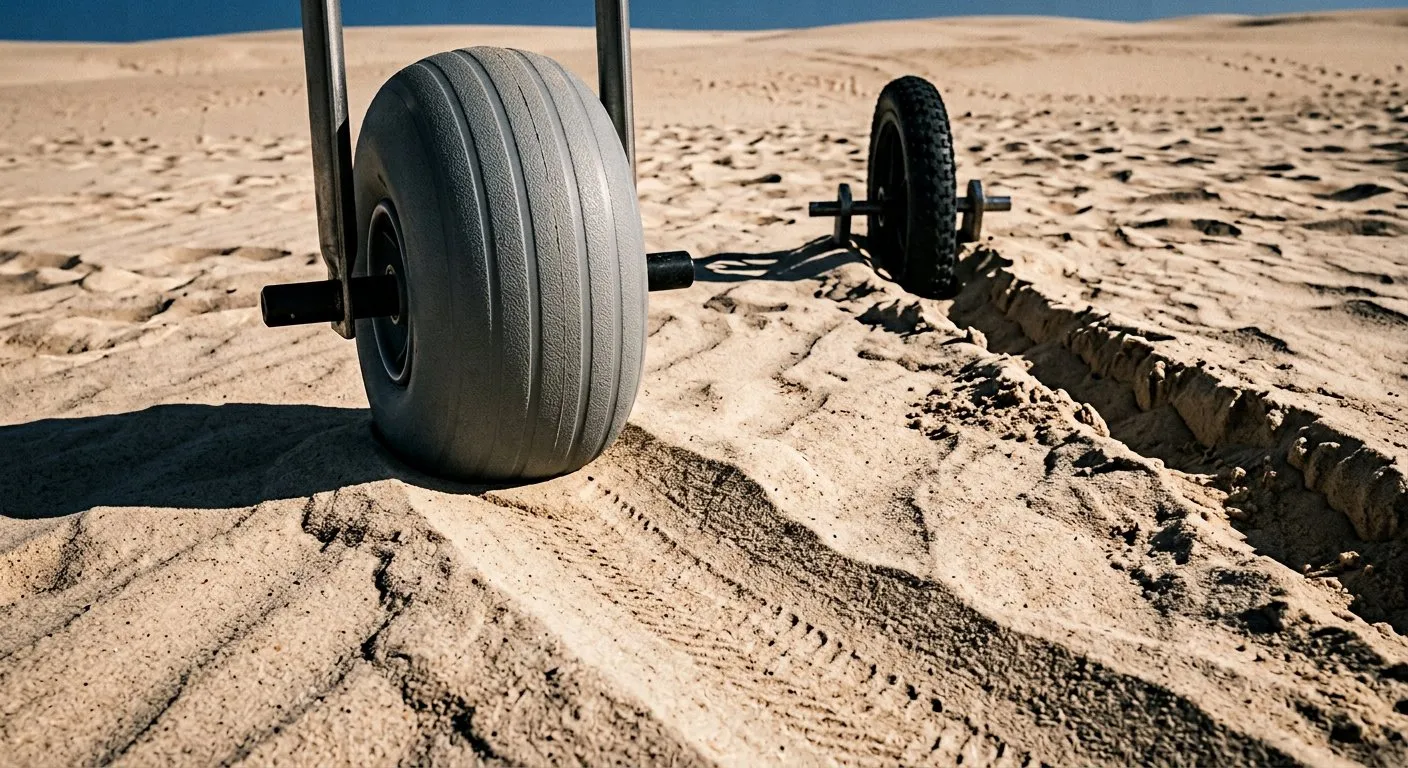
Width floats, diameter climbs
This is the single most useful thing to understand about cart wheels, and it is the opposite of what most people assume when they see a big wheel.
- Tyre width determines flotation. A wide tyre spreads the same load over more sand, reducing ground pressure so the wheel rides on top of the crust rather than through it.
- Tyre diameter determines obstacle clearance. A large wheel meets a kerb, root or step at a shallower angle, so less of your effort goes into lifting. Excellent on trails. Nearly irrelevant in sand.
A 38 cm diameter airless wheel that is only a few centimetres wide is a trail wheel. It will roll over driftwood beautifully and still sink in dry sand. A 30 cm balloon wheel that is 18 cm wide has a fraction of the obstacle performance and will float across the same beach.
A workable threshold
Below roughly 10 cm of tyre width, treat deep dry sand as out of scope regardless of what the product page says. Between 10 and 15 cm you are into “works with effort”. Above about 18 cm, with low pressure, sand stops being the limiting factor.
Some manufacturers are honest about this and deserve credit for it. YakAttack state that their standard 30.5 cm airless wheel is intended for hard-packed surfaces and is not a sand tyre, and sell a separate sand configuration instead of pretending one wheel does everything. If you launch off sand, buy the sand configuration from the start rather than buying the hard-surface version and hoping.
Tyre pressure is doing more work than you think
Low-pressure polyurethane balloon wheels are the purpose-built answer, and they only work if you run them soft. Wheeleez specify an ideal pressure of about 0.17 bar (2.5 psi), with a usable range of roughly 2 to 4 psi.
That is far softer than any pressure you have put in a tyre before, and it feels wrong. It is not. At 2.5 psi the tyre deforms across its whole width and lays down a long, wide contact patch. Inflate the same wheel to 15 psi and it becomes rigid, the contact patch shrinks to a narrow strip, and you have converted an expensive sand wheel into a heavy narrow wheel.
Over-inflation is the most common reason balloon wheels disappoint their owners. If yours are not floating, check the pressure before you blame the cart.
Verified balloon wheel sizes
| Diameter | Width | Load per wheel | Suits |
|---|---|---|---|
| 24 cm | 12.3 cm | 40 kg (88 lb) | Light boats, packs into a day hatch |
| 30 cm | 18 cm | 55 kg (121 lb) | The common beach cart size |
| 42 cm | 20 cm | 80 kg (176 lb) | Heavy boats, very soft sand |
| 49 cm | 23 cm | 120 kg (265 lb) | Heaviest loads, worst ground |
Manufacturer figures. Note that load is quoted per wheel, and that two 55 kg wheels do not reliably carry 110 kg on a beach — loads shift as the cart tilts and ruts throw weight onto one side. Leave margin. The weight calculator will show you how much you have.
What actually works, in order
- Wide low-pressure balloon wheels. The purpose-built solution. Nothing else is close on deep dry sand.
- Dedicated wide sand tyres sold as a distinct configuration by the cart maker.
- Wide deforming-tread wheels such as the SandTrakz option. A genuine improvement over standard wheels, though not balloon-wheel performance, and they appear to carry a lower load rating — check both figures before assuming you can simply swap.
- Everything else. Standard airless, flat-free and narrow pneumatic wheels are hard-surface equipment.
Compare every wheel we hold, across eight surfaces, in the wheel selector.
The capacity trap on sandy coasts
Beach carts frequently have lower capacity than heavy-duty platform carts, because balloon wheels have per-wheel load limits. If you have a heavy rigged fishing kayak and launch off soft sand, you are caught between two constraints at once, and plenty of carts satisfy one while failing the other. Run the finder with your real loaded weight rather than assuming a beach cart will cope.
Technique, which is worth real distance
- Use the tideline. Wet compacted sand near the water carries a cart far better than the dry stuff. Walk the firm strip and cut up to your spot at the last moment.
- Cross the soft band at its narrowest. Scout the shortest line through the dry sand rather than taking the most direct route to the water.
- Pull, do not push. Pulling from the bow keeps the wheels tracking straight; pushing tends to steer them sideways, and a sideways wheel digs in immediately.
- Keep moving. Momentum matters enormously in sand. Stopping lets the wheels settle, and restarting costs far more effort than continuing.
- Lighten the boat. Carry the crate, the battery and the cooler separately and make two trips. Two easy trips beat one that bogs down.
- Go at low tide where the beach profile allows it. More firm sand, shorter soft section.
When you bog down anyway
- Stop pulling harder. Force is what buries the wheels and what breaks kickstands and axles.
- Unload the boat and carry the heavy items clear.
- Lift and place, do not drag. Lift the cart out of the rut and set it down on fresh sand rather than dragging it out.
- Reduce pressure further if you are on balloon wheels and have a pump with you — you can go to the bottom of the recommended range.
- Change your line towards firmer sand rather than continuing on the same heading.
- Accept the carry. Sometimes the last ten metres are quicker on your shoulder, and it is easier on the equipment.
Do not shock-load a bogged cart
Yanking a stuck cart free is how axles bend, kickstands snap and straps tear out. The shock load is far higher than the static weight. Lift, reposition, continue.
Afterwards, because sand is not finished with you
Sand ingress into bearings and axle housings is one of the most frequently reported cart failures, and it happens on the beach you just crossed. Rinse the wheels and axles with fresh water before the salt dries, pull the wheels off periodically to flush grit out, and use a dry PTFE or silicone lubricant rather than grease — grease holds sand against the bearing surface and makes the problem considerably worse.
Full routine in saltwater cart care.
Check this against your own boat
General advice only gets you so far. The finder runs your kayak, your loaded weight and your launch terrain against every cart we hold.
Other guides
Start here
How to choose a kayak cart
The full decision process: rigged weight first, then hull shape, then terrain, then storage.
Technique
Strapping a kayak to a cart properly
Strap slip is the second most common cart complaint and it is almost always fixable.
Hull safety
Scupper cart safety
Scupper holes are moulded drains, not designed load points.
Ownership
Saltwater cart care
Salt and sand destroy carts faster than use does.